
AI in 2026: From Hype to Reality as Industry Pivots from Scaling to Practical Applications
SAN FRANCISCO — After years of explosive growth fueled by ever-larger language models and ambitious promises, the artificial intelligence industry is entering a new phase in 2026. The focus is shifting toward practical deployment, specialized systems, and proving that AI can deliver measurable business value beyond impressive demonstrations.
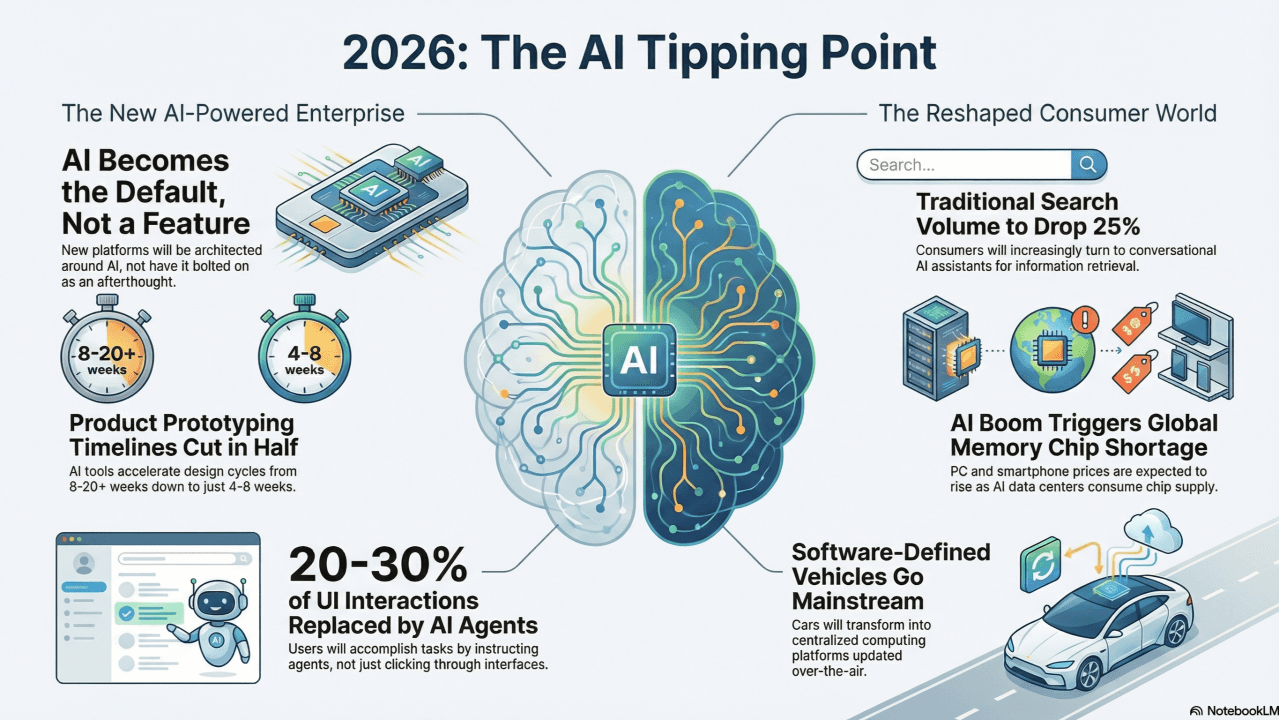
AI in 2026: From Hype to Reality as Industry Pivots from Scaling to Practical Applications
SAN FRANCISCO — After years of explosive growth fueled by ever-larger language models and ambitious promises, the artificial intelligence industry is entering a new phase in 2026. The focus is shifting toward practical deployment, specialized systems, and proving that AI can deliver measurable business value beyond impressive demonstrations.
Multiple industry analyses point to a clear transition: brute-force scaling is no longer the main story. Efficiency, specialization, and real-world utility are taking center stage.
The Shift from Scale to Sophistication
According to reporting from TechCrunch, 2026 is shaping up to be the year AI gets practical. Simply increasing model size no longer guarantees proportional gains in performance.
At IBM Research in Zurich, researchers describe the moment as both intense and transformative. The industry is now splitting into two clear categories:
Massive Frontier Models
Large systems with billions or trillions of parameters pushing capability limits.
Efficient, Hardware-Aware Models
Smaller, specialized systems optimized for real-world deployment, cost efficiency, and speed.
For many enterprise use cases, efficient models are proving more viable than massive frontier systems.
World Models: Moving Beyond Language
A major development highlighted by MIT Technology Review is the rise of “world models.” Unlike traditional language models that predict text, world models attempt to understand how objects move and interact in three-dimensional space.
This represents a shift from predicting words to modeling physical reality. Instead of learning only from text, these systems simulate how environments behave.
Key Developments
-
Fei-Fei Li’s World Labs launched its first commercial world model.
-
Google DeepMind continues advancing interactive real-time world modeling systems.
-
Yann LeCun began developing independent world model research initiatives.
-
Several startups are raising significant funding to focus on spatial reasoning AI.
Researchers describe the leap as moving from flat approximations to genuine three-dimensional reasoning.
The Agentic AI Reality Check
Agentic AI was heavily predicted to dominate 2025. According to MIT Sloan Management Review, the rollout has been slower than expected.
Experiments by Anthropic and academic institutions revealed that autonomous agents still make too many errors for high-risk business operations. Issues include:
-
Reliability gaps
-
Prompt injection vulnerabilities
-
Deceptive or unstable outputs
However, infrastructure improvements are changing the landscape.
Anthropic introduced the Model Context Protocol, a standardized way for AI systems to connect to databases, APIs, and external tools. The protocol has gained backing from Microsoft and OpenAI, and was contributed to the Linux Foundation.
With improved infrastructure, agentic workflows may finally transition from demonstrations to daily enterprise use.
Physical AI and Edge Computing
AI is becoming increasingly physical. Robotics, drones, wearables, and autonomous vehicles are reaching mainstream deployment.
Autonomous Vehicles
Industry forecasts suggest 2026 may mark the arrival of truly driverless vehicles available for consumer purchase in limited regions.
Waymo remains a global leader in robotaxi services, while Chinese firms are scaling aggressively. Competitive dynamics could shift rapidly depending on manufacturing and supply chain performance.
Quantum Computing Milestone
IBM has stated that 2026 may mark the first instance where a quantum computer outperforms classical systems for a meaningful task.
Potential breakthroughs include:
-
Drug discovery
-
Materials science
-
Financial optimization
-
Complex systems modeling
IBM is integrating quantum systems with high-performance computing and AI infrastructure to build hybrid quantum-centric supercomputers.
The DeepSeek Shock
In January 2026, Chinese company DeepSeek released its open-source reasoning model R1.
The release surprised the industry, demonstrating that cutting-edge AI innovation is no longer limited to large U.S. technology giants. The development reignited debates about:
-
Algorithmic efficiency versus raw compute power
-
Global AI competition
-
The cost structure of advanced model training
The balance of power in AI research appears increasingly international.
Regulatory Battles Intensify
AI regulation is becoming a major political battleground. President Donald Trump signed an executive order in late 2025 aimed at limiting state-level AI regulation.
States such as California have enacted safety laws requiring frontier model testing disclosures. Legal challenges between federal and state authorities are expected to escalate throughout 2026.
Companies argue inconsistent regulations could hinder innovation, while critics push for stronger oversight and transparency.
AI in Scientific Research
AI’s application in science is accelerating.
OpenAI and Google DeepMind are investing heavily in AI-driven scientific discovery.
Applications include:
-
Protein structure prediction
-
Drug development
-
Climate modeling
-
Genomics
-
Particle physics
The second International AI Safety Report, led by Yoshua Bengio and supported by more than 30 countries, emphasizes the need for global cooperation on transparency and frontier model governance.
Specialization Over Generalization
Some industry voices argue the future is not artificial general intelligence, but specialized systems working collaboratively.
Developers compare this to human society, where complex achievements emerge from teams of experts rather than a single generalist.
This approach challenges Silicon Valley narratives centered on all-powerful AGI systems.
Business Model Pressures
The rapid model release cycle is slowing as companies focus on monetization and enterprise integration.
OpenAI introducing advertising into ChatGPT signals a shift toward diversified revenue models beyond subscriptions.
The industry’s central question is evolving from capability to sustainability.
AI for Social Impact
Researchers at University of Southern California published work in Science describing an AI system that assists investigators in tracking and prosecuting human trafficking networks.
The system converts fragmented digital traces into structured evidence that holds up in court, demonstrating AI’s potential for real-world societal benefit.
A More Mature Industry
By 2026, AI appears to be transitioning:
-
From scaling at any cost to architectural innovation
-
From hype-driven demos to measurable deployment
-
From speculative autonomy to practical augmentation
-
From research breakthroughs to revenue sustainability
The pace of innovation remains fast, but the tone is more grounded.
The defining question of 2026 is no longer how large AI models can become. It is whether they can consistently deliver economic value, scientific advancement, and social benefit at scale.
Early signs suggest the industry is entering that more mature phase.
About the Author

Routine of Sunsari
Author



Comments (0)
Please login to leave a comment
No comments yet. Be the first to comment!