
HRW, Amnesty, and ICJ Demand Accountability for Nepal's 2025 Protest Killings as Election Nears
Human Rights Watch's World Report 2026 calls out Nepal's interim government over the killing of 19 protesters in September 2025. As the March 5 election approaches, international bodies demand all parties commit to ending impunity. #Nepal #HumanRights #GenZProtest #Accountability
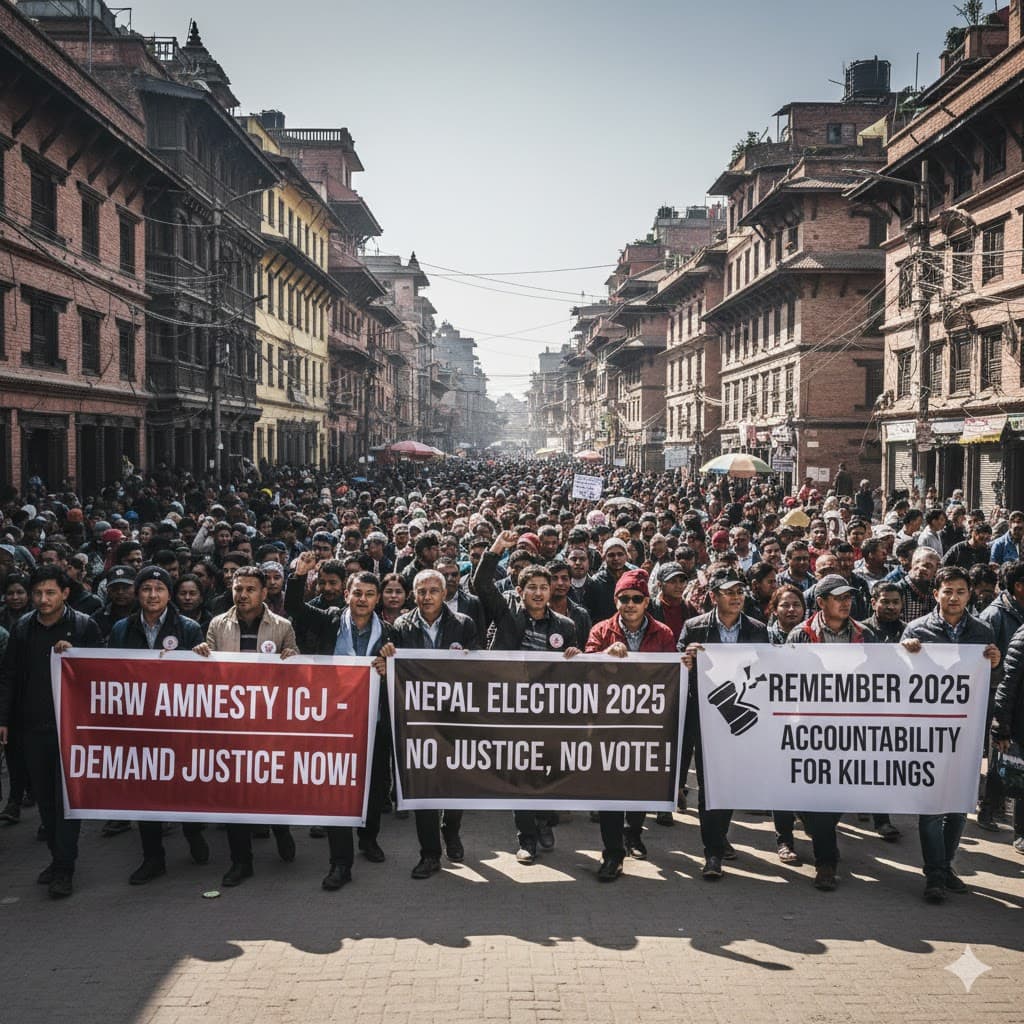
KATHMANDU, February 17, 2026 — As Nepal prepares for its March 5 general election, three of the world's most respected international human rights organisations have issued a unified demand: any government formed after the polls must end the culture of impunity that, they argue, directly caused the bloodshed of September 2025.
Human Rights Watch (HRW), Amnesty International, and the International Commission of Jurists (ICJ) published a joint statement this month calling on Nepal's interim government and all parties participating in the March 5 election to "commit to end impunity for rights abuses and corruption by upholding the rule of law, including by successfully completing the transitional justice process."
The statement is backed by HRW's World Report 2026, released on February 4, which dedicates significant attention to Nepal, documenting the events of September 2025 in disturbing detail.
WHAT HAPPENED IN SEPTEMBER 2025
The protests that upended Nepal's political order began as a student-led movement — now referred to widely as the Gen Z protests — targeting government corruption, inequality, and the authoritarian use of social media bans to suppress dissent. What started as online mobilisation rapidly became street demonstrations of extraordinary scale.
On September 8 and 9, 2025, the protests turned violent. According to the Nepal Army's official report, 76 people died in total — including 22 protesters, 3 police officers, and 10 prisoners who were shot to prevent their escape during mass jailbreaks. At least 2,113 were injured. More than 13,500 prisoners escaped from jails across the country during the chaos. Government offices, police posts, and media buildings were set on fire, including the Kantipur media house. International flights were diverted and Tribhuvan International Airport was briefly occupied by protesters.
Human Rights Watch found that police killed at least 19 protesters during the demonstrations. The report states that "impunity and failures to uphold rights contributed to lethal violence that toppled the government."
On September 12, parliament was dissolved and former Chief Justice Sushila Karki was sworn in as interim Prime Minister. President Ram Chandra Poudel simultaneously announced that elections would be held on March 5, 2026.
THE INTERIM GOVERNMENT'S RESPONSE
Karki took office committing to act on corruption, establish a judicial inquiry into the protest violence, and provide compensation to victims' families. Under her administration, families of those killed have been promised monetary compensation of 1 million Nepalese rupees — approximately US $7,000 — per victim, which is the maximum amount permitted under Nepali law. Injured protesters are also to receive compensation.
Karki has pledged to remain in power for no more than six months and has focused her caretaker administration on creating conditions for a credible election rather than pursuing deep structural reforms, which she views as the mandate of the elected government that follows.
Human rights advocates acknowledge these steps while arguing they are insufficient. Compensation, they say, is not accountability.
THE DEEPER PROBLEM: STRUCTURAL IMPUNITY
HRW Deputy Asia Director Meenakshi Ganguly was direct about the structural failure: "The failure of successive governments to hold people accountable for human rights abuses and widespread corruption have undermined the rights of all Nepalis and led to repeated abuses."
The September protests did not emerge from nowhere. They were, in many ways, the culmination of years of accumulated grievance — over economic stagnation, migration, lack of opportunity, political corruption, and the failure of democratic institutions to deliver on their promises.
Nepal's transitional justice process — designed to reckon with human rights violations committed during the 1996-2006 civil conflict — has stalled repeatedly. Victims' groups rejected the commissioners appointed to the process, citing concerns about political interference and lack of independence. That unresolved legacy of impunity has cast a long shadow over every subsequent political crisis.
The three international organisations argue that the March 5 elections cannot simply reset the clock. The new government must grapple directly with accountability for the 2025 killings, as well as the unfinished business of the conflict-era transitional justice process.
Their specific recommendations include:
— A credible, independent judicial inquiry into the killing of protesters, with findings made public and those responsible held accountable.
— Genuine progress on transitional justice for 1996-2006 conflict-era violations, incorporating victims' concerns.
— Expansion of the Child Grant to all Nepali children, noting that less than 10 percent of children currently benefit from the social security programme.
— An end to the detention of individuals for peaceful online expression and speech.
A YOUNG POPULATION WITHOUT OPPORTUNITY
The HRW report also highlights a structural issue that goes to the heart of the protests: Nepal's demography and its failure to generate opportunity. Forty percent of Nepal's population is under the age of 18. Economic opportunities are few, and successive governments have failed to expand either social protection or job creation sufficiently to keep young people in the country.
The Gen Z activists who led the movement marched under the banner "Don't Forget the Blood of Martyrs," demanding justice for those killed during the protests and accountability from political leaders. Many of these same young people are now first-time voters in the March 5 election.
Whether they trust the ballot box after watching their peers shot in the streets is one of the defining questions of this election cycle.
WHAT THE PARTIES ARE SAYING — AND NOT SAYING
Political parties have responded to the 2025 protests in sharply divergent ways, and those divergences will shape the election.
CPN-UML, led by KP Sharma Oli, has characterised the September protests as a "conspiracy against the nation." Party Deputy General Secretary Lekhraj Bhatta told the Kathmandu Post that the party's manifesto will highlight "the harm caused to the country" by the movement, using September 9 as a reference point for destruction.
The Nepali Communist Party's manifesto, by contrast, emphasises incorporating the demands of the 2025 Gen Z protests into constitutional amendments, signalling a more sympathetic reading of the uprising.
The Rastriya Swatantra Party, which draws significant support from younger urban voters, has positioned itself as a vehicle for the change the protests demanded, though its full manifesto is yet to be released.
Human rights groups are monitoring all parties closely. The joint HRW-Amnesty-ICJ statement makes clear that commitments to accountability and rule of law will be a benchmark against which the new government is judged — not just domestically, but internationally.
THE ROAD TO MARCH 5
Sixteen days remain until Nepal votes. The country that emerged from September 2025 is different from the one that entered it. The question now is whether the election will produce a government capable of meeting the moment — one that can address the structural injustices that drove the protests while building the stable, accountable institutions that Nepal's democracy has long promised and too rarely delivered.
For the families of the 22 protesters who never came home, that question is not abstract. It is everything.
About the Author

Routine of Sunsari
Author
Comments (0)
Please login to leave a comment
No comments yet. Be the first to comment!