
Kathmandu's Air is Killing People — And Nobody in Power Seems to Care
Bir Hospital's wards are full. Doctors say even young people are arriving with serious breathing problems they cannot accommodate. Kathmandu's AQI hit 175 this week. Vehicle emission testing has been stopped for eight months. And the government says it cannot fix the problem before March 5. #AirPollution #KathmanduHealth #PublicHealth
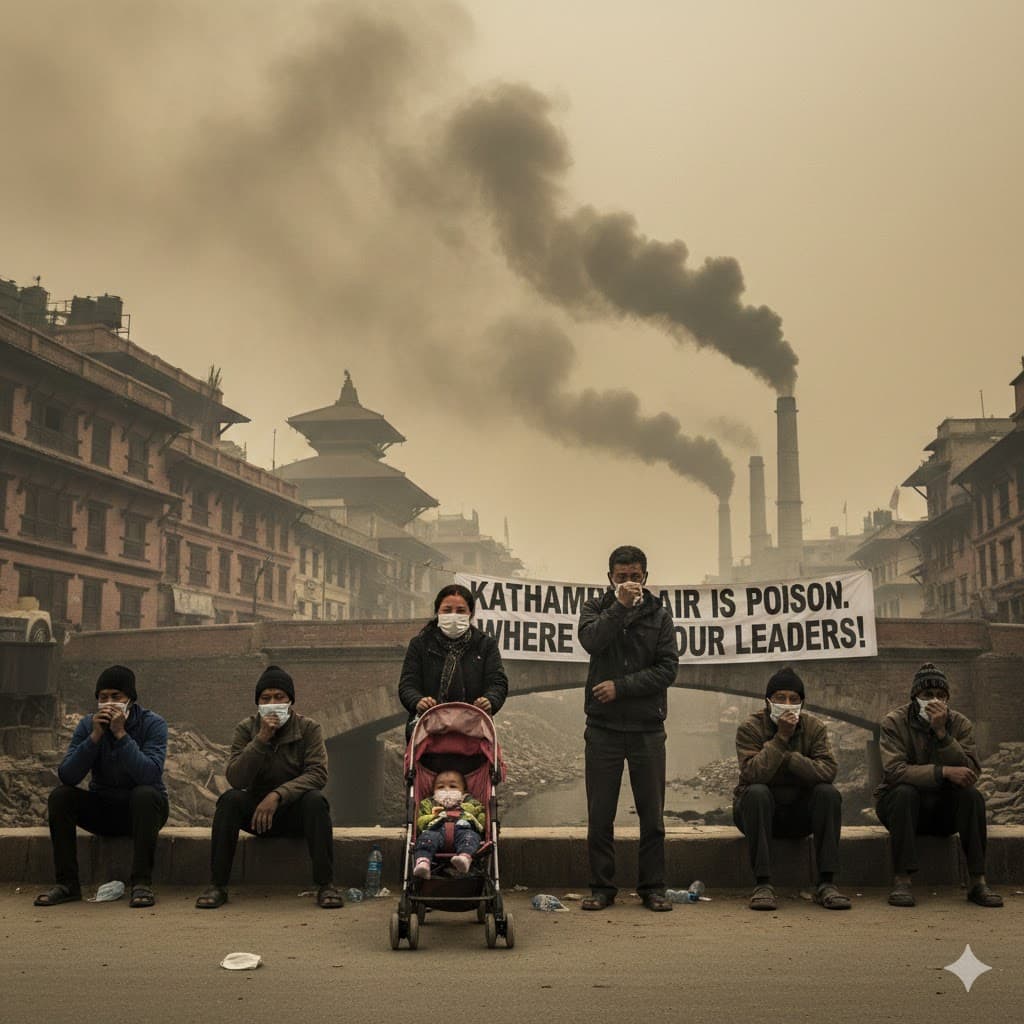
KATHMANDU'S AIR IS KILLING PEOPLE — AND NOBODY IN POWER SEEMS TO CARE
KATHMANDU, February 17, 2026 — The wards at Bir Hospital are full. Patients sit in corridors waiting for beds. Doctors warn they cannot accommodate all the seriously ill patients arriving daily with pneumonia, bronchitis, and severe asthma. Outside the hospital, the air quality index in Kathmandu recently reached 175 — a level classified as "Unhealthy" — making Nepal's capital one of the most polluted cities on the planet this week.
This is not a new story. But it has never been this bad. And the institutions that should be fixing it have, almost without exception, failed to act.
A HOSPITAL SYSTEM PUSHED TO THE BRINK
Since the second week of January, cases of pneumonia, influenza, asthma, bronchitis, and chronic obstructive pulmonary disease have surged across Kathmandu Valley hospitals, according to doctors at multiple facilities.
"Even very young people are suffering from bronchitis, asthma and pneumonia and other respiratory problems," said Dr Ashes Dhungana, a pulmonologist and critical care physician at Bir Hospital. "Some patients require intensive care, but we don't have enough beds to accommodate all seriously ill patients."
At Dhumbarahi-based HAMS Hospital, two-thirds of all patients visiting pulmonary and medicine units in recent weeks are suffering from respiratory illnesses — cold, dry cough, bronchitis, or pneumonia. Some arrived after their conditions had already worsened considerably, presenting with shortness of breath, chest tightness, and constant wheezing.
"The number of patients suffering from respiratory illness has risen sharply in recent days," said Dr Raju Pangeni, a pulmonary and critical care physician at HAMS. "The rise in patient numbers can be linked to the growing air pollution, as every year respiratory cases surge with a rise in pollution levels."
At Sukraraj Tropical and Infectious Diseases Hospital, around 1,000 patients — mostly with respiratory problems — were visiting the outpatient department daily, according to director Dr Yuba Nidhi Basaula. The hospital is not even monitoring which specific viruses are spreading. "Only those who are getting severe are seeking treatment," said Dr Sher Bahadur Pun, chief of the Clinical Research Unit. "We are not monitoring which virus is spreading or which one is responsible for the severity of the illness."
That is a public health surveillance gap that should alarm any responsible government.
THE NUMBERS BEHIND THE CRISIS
The International Centre for Integrated Mountain Development (ICIMOD)'s air quality monitoring station in Khumaltar recorded an average PM2.5 concentration of 45 micrograms per cubic metre in December 2025. Between December 2025 and February 2026, the mean PM2.5 level hovered around 50 µg/m³ — far above the World Health Organisation's safety threshold, which recommends an annual average of no more than 5 µg/m³ and a 24-hour maximum of 15 µg/m³.
For context, Kathmandu's air this winter has carried particulate matter at concentrations roughly ten times what the WHO considers safe for human health.
PM2.5 matters because particles of that size penetrate deeply into the lungs and other vital organs. In the short term, exposure causes pneumonia, bronchitis, conjunctivitis, stroke, and heart problems. Long-term exposure leads to lung cancer, kidney disease, intestinal complications, and severe cardiovascular disease. A World Bank report released in June 2025 found that air pollution has now become the single leading risk factor for death and disability in Nepal, surpassing both malnutrition and tobacco use. It cuts the life expectancy of the average Nepali by 3.4 years and causes approximately 26,000 premature deaths every year.
Nepal has the world's highest age-standardised death rate for chronic lung disease caused by air pollution — 182.5 deaths per 100,000 population. The country ranks 175th out of 180 nations in the Environmental Performance Index for air quality.
These are not projections or estimates. They are documented outcomes of a crisis that has been building for years.
HOW DID IT GET THIS BAD?
Kathmandu's pollution sources are well understood: vehicle exhaust, brick kilns, road dust, construction activity, cooking fires, and transboundary pollution drifting in from the Indo-Gangetic Plain. The city's bowl-shaped geography, surrounded by mountains, traps pollutants close to the ground, especially in winter when cold air settles into the valley.
But what has made this season particularly severe is a combination of structural failures and administrative negligence.
Vehicle emission testing — one of the most basic tools for reducing vehicle pollution — has not been conducted in Kathmandu since June 2025. The reason given by the Kathmandu Metropolitan City government is extraordinary in its banality: the mechanical engineer hired on a contract basis to conduct testing accepted a better job elsewhere, and no replacement has been found. Tests carried out before the halt found that approximately 80 percent of diesel-fuelled vehicles on Kathmandu's roads — buses, microbuses, and pickup trucks — emit black smoke beyond permissible levels.
"We have not been able to resume emission testing in the ongoing fiscal year, due to various reasons," said Sarita Rai, chief of the Environment Department under the city office. She added that testing would not resume before the March 5 elections.
In other words, the government acknowledges that tens of thousands of illegal-emission vehicles are polluting the air, knows that hospitals are overwhelmed, and has decided that resuming basic environmental enforcement can wait until after election day.
In addition, over 1,200 brick kiln operators across the country resumed seasonal firing in recent weeks, a predictable annual addition to already dangerous pollution levels. Forest fires — historically the dominant pollution source during the dry February-to-May season — have not yet begun in earnest but will further worsen air quality in coming months.
The Kathmandu Valley Air Quality Management Action Plan and the National Environment Policy, 2076, exist on paper. According to critics, they exist almost exclusively on paper. Experts say these documents have gathered dust on government shelves while the air has gathered far more dangerous things in the lungs of ordinary Nepalis.
A CRISIS WITHOUT ACCOUNTABILITY
What makes this situation particularly tragic is that solutions are known and documented. The World Bank's June 2025 report recommended a multi-sectoral approach including accelerated electrification of vehicle fleets, stricter vehicle inspection and maintenance, reducing road dust, and controlling industrial emissions from brick kilns and boilers.
Air quality expert Bhusan Tuladhar has called the situation a public health emergency. "Most of us are aware of the crisis and have personally been affected. So we must act with urgency to address the problems."
But urgency has been absent. The government has been in caretaker mode since September 2025, focused entirely on election preparation. Political parties are publishing manifestos about economic growth and infrastructure while tens of thousands of Nepalis breathe air that is slowly damaging their organs. None of the major party manifestos have placed air pollution at the centre of their health agendas, despite it being the leading cause of death and disability in the country.
Consultant pulmonologist Dr Pangeni, who has watched this pattern repeat for years, was direct: "Every year, the same problems repeat and we talk about the same issues. Wearing masks is not a solution, and for a durable response, efforts at the individual level are not sufficient. National and global efforts are needed."
The pre-monsoon season is approaching. Dry weather will bring more road dust. Hillside fires will ignite. The air will worsen before it improves.
For the patients already lying in Bir Hospital's corridors, waiting for a bed that may not come, the election campaign promises feel very far away.
About the Author

Routine of Sunsari
Author
Comments (0)
Please login to leave a comment
No comments yet. Be the first to comment!