Nepal's March 5 Election: Parties, Promises, and the Race to Lead a Nation in Transition
Nepal heads to the polls on March 5 in its first general election since the 2025 Gen Z uprising toppled the government. With 120 parties in the race, manifestos flying and campaigning in full swing, here is everything you need to know.
NEPAL'S MARCH 5 ELECTION: PARTIES, PROMISES, AND THE RACE TO LEAD A NATION IN TRANSITION
KATHMANDU, February 17, 2026 — With just over two weeks remaining before Nepal's landmark House of Representatives election on March 5, political parties are racing to finalise their manifestos, candidates are knocking on doors, and the Election Commission is busy issuing notices to those who cannot seem to follow the rules. It is, in every sense, Nepal's most consequential vote in a generation.
The election was announced on September 12, 2025 by President Ram Chandra Poudel after the Federal Parliament was dissolved following massive Gen Z-led protests that shook the country and toppled the government. Interim Prime Minister Sushila Karki, a former chief justice, was sworn in with a mandate to oversee free and fair elections and pledged to remain in power for no more than six months.
That clock is now ticking loudly.
WHAT IS AT STAKE
Nepal will elect all 275 members of the House of Representatives through a dual ballot system. Citizens will cast one vote for 165 members from single-member constituencies under a First Past the Post system, and a second vote for the remaining 110 members through party-list proportional representation. In total, 120 political parties registered with the Election Commission to contest the polls, and 64 parties submitted closed lists for proportional representation seats.
The stakes could not be higher. Nepal has cycled through more than a dozen governments since 2008. The 2025 protests — which killed at least 19 people and saw widespread arson, prison breakouts, and the dissolution of parliament — were a direct response to public frustration with political instability, corruption, and the failure of successive governments to deliver economic opportunities to ordinary Nepalis. Forty percent of Nepal's population is under the age of 18, and many young people see migration abroad as their only option for a better life.
Whoever wins on March 5 will inherit a country hungry for change but deeply divided about what change should look like.
THE KEY PARTIES AND THEIR PROMISES
Nepali Congress (NC)
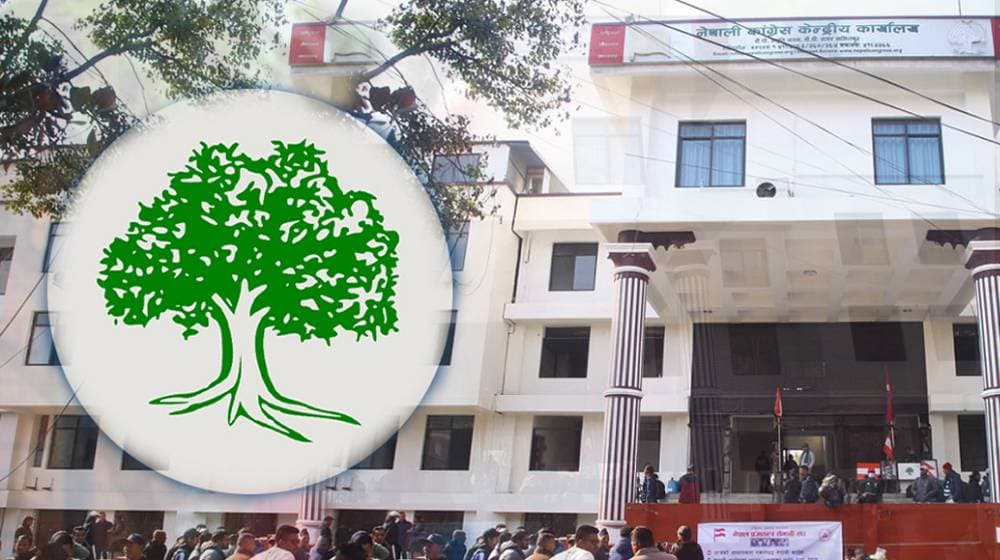
The Nepali Congress, Nepal's oldest democratic party, is competing with its credibility on the line. Spokesperson Devraj Chalise recently emphasised the party's commitment to accept the people's verdict and uphold democratic responsibility. The party will hold a mass meeting in Janakpur on February 18 and plans to unveil its full election commitment paper the same day. NC has pledged to engage citizens at the grassroots level and promote a revised, pro-public administration agenda. However, the party was among 37 of 68 parties — including CPN-UML — that did not comply with the Election Commission's deadline to unveil their documents before beginning campaigning, drawing criticism for putting mobilisation ahead of transparency.
CPN-UML
The Communist Party of Nepal (Unified Marxist-Leninist), led by former Prime Minister KP Sharma Oli, reelected Oli as its chairman at its 11th general convention in December 2025. The party is fielding candidates in all 165 constituencies and has declared Oli as its candidate for prime minister. CPN-UML's manifesto, expected by February 19, will focus on economic development, good governance, and service delivery. Notably, party Deputy General Secretary Lekhraj Bhatta indicated the manifesto will address the Gen Z protests — framing them as a "conspiracy against the nation" — a position that risks alienating younger voters who broadly supported the uprising. Oli himself is contesting from Jhapa-5, where he faces a high-profile challenge from Balen Shah, the popular former Kathmandu mayor running under the Rastriya Swatantra Party banner.
Nepali Communist Party (NCP)
Formed from the merger of 22 communist and socialist factions including CPN (Maoist Centre) led by Pushpa Kamal Dahal 'Prachanda' and CPN (Unified Socialist) led by Madhav Kumar Nepal, the NCP unveiled its 57-page manifesto on February 11. The document sets ambitious, time-bound targets: achieving double-digit GDP growth above 10 percent within five years, reducing multidimensional poverty from 20.15 percent to 5 percent, creating 1.5 million formal jobs, and transforming 100,000 returnee migrant youth into entrepreneurs. The manifesto also promises the long-delayed Nijgadh International Airport, smart cities, and universal drinking water coverage. Critics note, however, that many of these same pledges featured in the 2017 and 2022 platforms of the same party leaders, when implementation consistently lagged far behind rhetoric.
Rastriya Swatantra Party (RSP)
The RSP, led by Rabi Lamichhane — who escaped prison during the 2025 protests and is now contesting from Jhapa-5 — released a preliminary one-pager "contract paper" on February 16, pledging to uphold liberal economy with social justice, reformed provincial structures, inclusive representation, and respect for Sanatan civilisation. The party's full manifesto is expected by February 20. Lamichhane's candidacy in Jhapa-5 directly against KP Sharma Oli has made it one of the most watched constituencies in the country. The party has also faced scrutiny: Balen Shah, the RSP candidate in Jhapa-5, received a second clarification notice from the Election Commission after audio-visual evidence emerged allegedly showing plainclothes police officers accompanying his wife during election outreach.
Rastriya Prajatantra Party (RPP)
RPP Chair Rajendra Lingden released the party's "Commitment Letter" at the RPP central office this week, re-emphasising the party's core agenda: reinstating the monarchy as a guardian institution, establishing Nepal as a Vedic Sanatan Hindu state with religious freedom, and scrapping the federal provincial structure in favour of a two-tier governance model comprising a strong central government and empowered local governments. The RPP also unified with the Rastriya Prajatantra Party Nepal ahead of the election to consolidate the pro-monarchy vote. Notably, the party has dropped its earlier demand for a directly elected prime minister from this cycle's manifesto, focusing instead on the "Prithvi Path" philosophy rooted in the ideals of King Prithvi Narayan Shah.
Ujyaalo Nepal Party (UNP)
Led by Kulman Ghising, the man credited with fixing Kathmandu's once-chaotic electricity supply, the UNP released its manifesto under the striking slogan: "No Gossip, No Speeches, Results." The party's platform is distinctly technocratic: generating 12,000 megawatts of electricity by 2030, making Nepal an energy-exporting country, achieving 9 percent annual GDP growth, raising annual revenue to nearly USD 7 billion by 2030, and providing free education up to university level and free healthcare at designated institutions. Ghising pledged to cut the number of federal MPs from 275 to 201 and provincial legislators from 550 to 330 to reduce state spending, and announced a zero-tolerance policy on corruption with a lifetime ban from public office for those found guilty.
ELECTION COMMISSION CRACKS DOWN
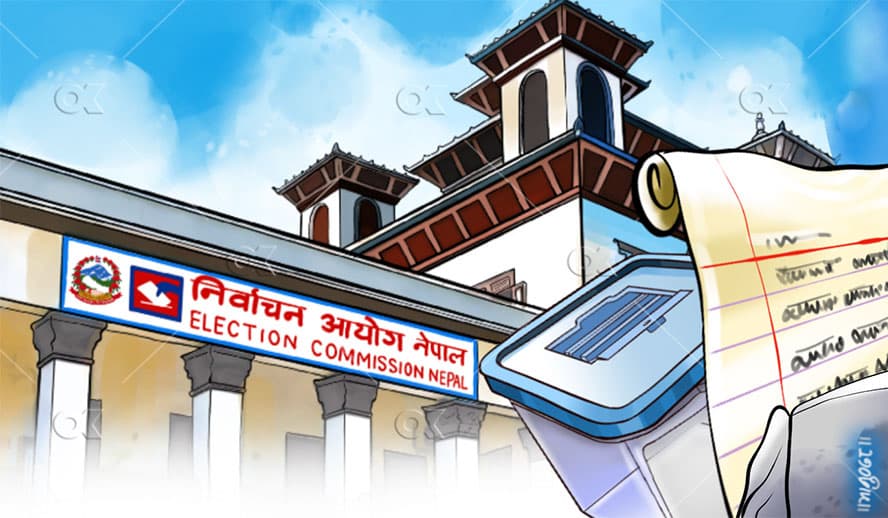
The Election Commission is struggling to maintain order amid widespread code-of-conduct violations. To date, the Commission has issued 29 clarification notices and received 14 responses. Cases involving misleading media reports have been forwarded to Press Council Nepal. The Commission has also requested legal action against several journalists for continuously posting candidate promotional materials on their personal social media accounts, which violates Section 7 of the Election Code of Conduct 2026.
To regulate transport, the Commission issued the Vehicle Permission Procedure 2026, restricting candidates to two light vehicles for campaigning and banning foreign-registered vehicles entirely. A 48-hour silence period before voting will keep all non-essential vehicles off roads.
Security has also been dramatically scaled up. The Nepal Army has increased patrols at sensitive locations including airports, prisons, and government installations, while the Nepal Police and Armed Police Force cover the first two security tiers. India has donated 223 vehicles to assist Nepal's election logistics. Madhesh Province polling stations are on high alert given past violence, bitter political rivalries, and the porous open border.
THE BROADER PICTURE
Political analysts are noting a troubling trend: Nepal's election is increasingly personality-centred rather than policy-driven, with major parties projecting specific individuals as prime ministerial candidates while institutional manifestos play a secondary role. Sociologist Uddhab Pyakurel told the Kathmandu Post that many parties treat manifesto-making as a ritual rather than a genuine commitment, publishing ambitious targets they have no realistic plan to deliver.
The ultimate test for whoever wins on March 5 will not be the promises made on campaign stages. It will be whether they can reverse the deep cynicism that drove hundreds of thousands of young Nepalis into the streets in 2025 — and whether they can finally give the next generation a reason to stay home, rather than seek their futures abroad.
Nepal votes on March 5. The world is watching.
About the Author

Routine of Sunsari
Author
Comments (0)
Please login to leave a comment
No comments yet. Be the first to comment!